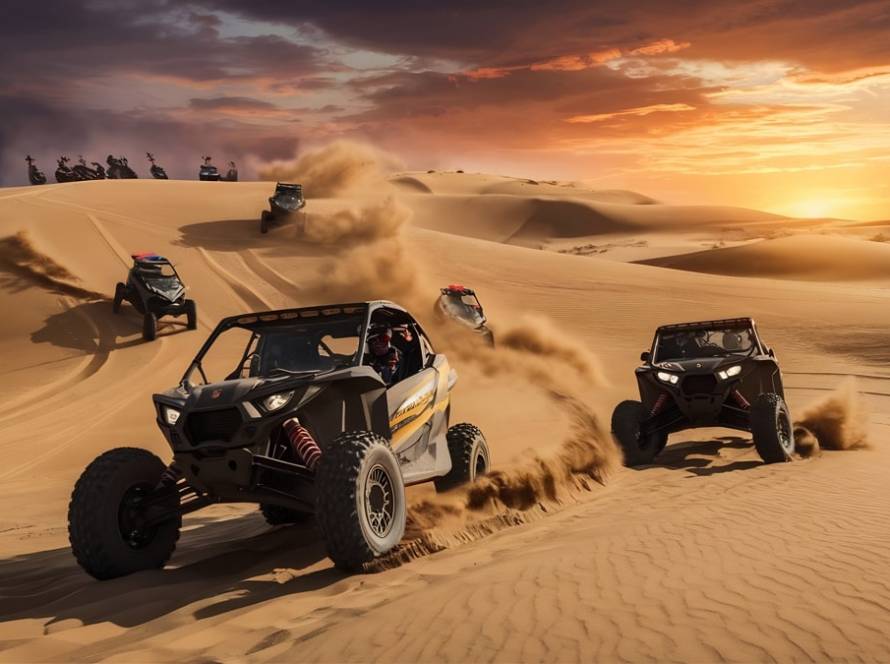
Imagine the sun dipping toward the horizon, painting the towering Big Red Dunes of Al Badayer in shades of deep crimson and gold. You’re standing at the crest of a 300-foot sand mountain, looking down a slope that feels like a vertical drop. In this moment, the only thing between you and the thrill of a lifetime or a very bumpy, uncomfortable afternoon is the machine beneath you.
Many travelers arrive in Dubai and book a “4×4 Desert Safari” assuming every SUV is created equal. This is the most common mistake first-timers make. In the city, a luxury crossover looks great; on the shifting, unpredictable sands of the Arabian Desert, it’s a liability. To conquer these dunes, you don’t just need four-wheel drive; you need a desert beast capable of handling high-torque climbs and rapid-fire suspension shifts without breaking a sweat.
Quick Answer: The best cars for a Dubai desert safari are the Toyota Land Cruiser 300 Series and the Nissan Patrol. These vehicles are the industry standards because they offer the perfect balance of engine power, high ground clearance, and advanced cooling systems required to navigate deep sand safely.
As someone who has spent over a decade navigating the vast “Empty Quarter” and the challenging Lahbab dunes, I’ve seen exactly which vehicles thrive and which ones get stuck before the first photo op. Selecting the right car isn’t just about the “cool factor” it’s about ensuring your safety while delivering the high-speed adrenaline rush you came to Dubai to find.
The “Big Two”: Toyota Land Cruiser vs. Nissan Patrol
In the world of Dubai desert safaris, two names reign supreme. If you stand at the entrance of a desert camp at sunset, you will see a sea of white SUVs, and almost every single one will be a Toyota Land Cruiser or a Nissan Patrol. These aren’t just cars; they are cultural icons in the UAE. But which one should you choose for your adventure?
The Toyota Land Cruiser 300 Series: The King of the Desert
For decades, the Land Cruiser has been the undisputed “King of the Desert.” The latest 300 Series has taken that reputation to a new level. Under the hood, the traditional V8 has been replaced by a 3.5L Twin-Turbo V6, which actually provides more punch and quicker response when you’re trying to climb a steep dune.
What makes the Land Cruiser a favorite for professional tour operators is its legendary reliability. It features a system called Crawl Control, which acts like an off-road cruise control. If the car gets deep into soft sand, the computer can manage the braking and acceleration of each individual wheel to “dance” the car out of a sticky situation. For a passenger, this means a smoother, more confident ride through even the most intimidating terrain.
The Nissan Patrol (2026 Refresh): The Hero of All Terrains
If the Land Cruiser is the king, the Nissan Patrol is the “Hero.” Known locally as the “Al Batall,” the Patrol is famous for its raw, brute strength. The 5.6L V8 engine produces a roar that echoes across the dunes, providing the high-end torque needed for “dune bashing”—the art of driving sideways across a sand slope.
One of the Patrol’s biggest advantages is its Hydraulic Body Motion Control (HBMC). This system keeps the car remarkably level. When other SUVs are leaning precariously to the side on a dune, the Patrol stays braced and stable. It is often described as having a superior “float” on the sand, making it feel less like a heavy truck and more like a powerful boat gliding over waves.
Direct Comparison: At a Glance
| Feature | Toyota Land Cruiser 300 | Nissan Patrol (V8) |
| Engine | 3.5L Twin-Turbo V6 | 5.6L V8 |
| Horsepower | 409 hp | 400 hp |
| Torque | 650 \ Nm | $560 \ Nm |
| Ground Clearance | 235 mm | 273 mm |
| Seating Capacity | 7-8 Passengers | 7-8 Passengers |
The Verdict: Thrill vs. Luxury
Choosing between these two often comes down to the “feel” of the ride.
-
The Thrill-Seeker’s Choice: Go with the Nissan Patrol. The V8 engine’s sound and the way it handles high-speed maneuvers make it feel aggressive and exciting. It’s the choice for those who want to feel the power behind every turn.
-
The Luxury & Comfort Choice: Go with the Toyota Land Cruiser. While it is incredibly capable, it feels more refined. The cabin is typically quieter, and the suspension is tuned to absorb the “thud” of landing after a jump, making it the better option for families or those who want a premium experience without the soreness the next morning.
In reality, you cannot go wrong with either. Both are built to survive the harshest environments on Earth, ensuring that your desert story ends with a smile and a great photo, rather than a tow truck.
The Adrenaline Alternatives: For the Raw Thrill-Seekers
While the Land Cruiser and Patrol are the kings of the desert, some travelers want a ride that feels a bit more “raw.” If you are looking for a vehicle that prioritizes mechanical grit and high-speed jumps over cabin quietness, these alternatives are where the real excitement begins.
Jeep Wrangler Rubicon: The “Cheat Code” for Dunes
The Jeep Wrangler Rubicon is a favorite for those who want to feel every grain of sand. Its secret weapon is its short wheelbase (the distance between the front and back wheels). In the desert, a shorter car is much less likely to get “high-centered” or stuck on the peak of a sharp dune ridge.
Think of it as a “cheat code” for steep climbing. Because it is lightweight and nimble, it can weave through tight dune “bowls” that would make larger SUVs struggle. When you take the doors and roof off, the experience becomes immersive you aren’t just watching the desert; you are part of it.
Ford F-150 Raptor: The Desert Racer
If the Jeep is a nimble mountain goat, the Ford Raptor is a trophy truck. This vehicle was specifically designed for high-speed desert running. What sets it apart is the Fox Racing Shox technology. These aren’t standard shocks; they are professional-grade bypass dampers that can adjust hundreds of times per second.
When a Raptor hits a bump at 80 km/h, the suspension “eats” the impact, allowing the truck to stay level while the wheels do the heavy lifting. It is the only factory-built truck that lets you experience what it’s like to be a professional desert racer in the Dakar Rally.
Luxury Beasts: VIP Desert Crossing
For those who want to arrive at the desert camp in ultimate style, two European icons stand out:
-
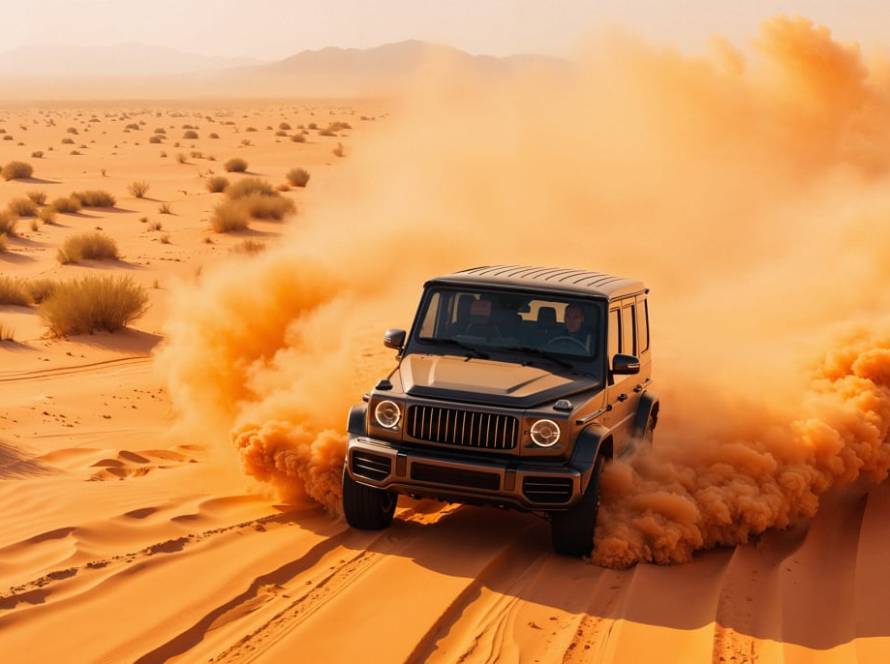
Mercedes G-Wagon (G63): With three locking differentials and a twin-turbo V8, it is surprisingly capable on sand. It offers the highest prestige, making it the top choice for VIP private tours.
-
Land Rover Defender 130: The extended “130” model is perfect for large families who don’t want to sacrifice luxury. It uses advanced air suspension to lift the body higher off the sand at the touch of a button.
Dune Buggies vs. SUVs: Taking the Wheel
If being a passenger isn’t enough, you should look into a Self-Drive Dune Buggy. Unlike an SUV, which is a road car modified for sand, these are “Side-by-Sides” (UTVs) built only for the dirt.
-
Can-Am Maverick X3: This is the gold standard for power. It’s turbocharged, sits low to the ground, and feels like a rocket ship on the sand. It’s best for those who want maximum speed and aren’t afraid of a little dust.
-
Polaris RZR: Known for being slightly more “user-friendly,” the Polaris is agile and easier to steer for beginners. It still offers incredible thrills but feels a bit more stable for someone who has never driven on a sand dune before.
Choosing a buggy gives you the ultimate sense of control, as you follow a lead guide through the valley, choosing your own lines and feeling the torque directly in your hands.
Technical Checklist: What Makes a Car “Desert Ready”?
Even the most powerful SUV can fail in the desert if it isn’t properly prepared. When you are miles away from the nearest paved road, your vehicle’s technical specs become your lifeline. Here is the essential checklist that separates a “city car” from a true desert explorer.
The 4×4 System and “Low Range” Gearing
Not all four-wheel-drive systems are the same. For serious dune bashing, a vehicle must have a transfer case with Low Range (4L) gearing. While High Range (4H) is great for fast driving on flat sand, Low Range multiplies the engine’s torque. This gives the car the “grunt” needed to pull its own weight up a steep, 40-degree sand incline without stalling or overheating the transmission.
Ground Clearance: The 9-Inch Rule
In the desert, the “belly” of your car is its weakest point. If your frame hits the crest of a dune, your wheels will lift off the ground, leaving you “beached” and spinning your tires in the air. Expert operators look for a minimum ground clearance of 9 to 11 inches. This height allows the car to pass over the sharp peaks of dunes and navigate deep ruts left by other vehicles.
Heavy-Duty Cooling Systems
Dubai’s desert temperatures regularly soar above 45°C (113°F). Pushing a heavy SUV through soft sand generates immense internal heat. A “Desert Ready” car often features upgraded radiators, larger cooling fans, and specialized transmission coolers. Without these, an engine can hit the “red zone” in less than 20 minutes of intense play, leading to an expensive and dangerous breakdown in the middle of the dunes.
Tire Tech: The Science of Deflation
The secret to “floating” on sand isn’t the tire’s tread it’s the surface area. Professional guides use All-Terrain (AT) tires because they have reinforced sidewalls that can handle being driven while soft.
Before entering the dunes, we deflate the tires from the standard 35 PSI down to 15–18 PSI. This “flattens” the tire, creating a much larger footprint (or “patch”) on the sand. This prevents the rubber from digging in like a blade and instead allows the vehicle to glide across the surface, much like a person wearing snowshoes.
Safety: Don’t Risk Your Life in the Dunes
In the desert, the margin for error is slim. While we focus on the “thrills,” safety is the foundation of every successful safari. Because the desert is a remote and physically demanding environment, you must treat your vehicle and your preparation with the respect they deserve.
The Driver: The Most Important “Part” of the Car
Even a million-dollar SUV is useless in the sand if the person behind the wheel doesn’t know how to “read” the dunes. In Dubai, professional safari drivers must hold a specialized Safari Driving Permit issued by the RTA. This requires passing rigorous tests on dune handling and emergency recovery. For foreign visitors, I always recommend booking with a licensed operator rather than attempting a self-drive. A pro knows how to crest a dune without rolling the vehicle a skill that takes years to master.
Essential Recovery Gear
If you are venturing into the sand, your car must be a traveling toolbox. Getting stuck isn’t a possibility; it’s an inevitability. Every desert-ready vehicle should carry:
-
Heavy-Duty Shovels: For clearing sand from under the chassis.
-
Kinetic Recovery Ropes: Unlike standard tow ropes, these stretch and “snap” a stuck car out using kinetic energy.
-
Sand Plates (Traction Mats): Sturdy boards you place under the tires to give them a solid surface to grip.
-
Air Compressors: Essential for re-inflating your tires to road pressure before you get back on the highway.
Emergency Communication
Once you enter deep desert areas like the Empty Quarter (Rub’ al Khali), standard mobile signals often vanish. While GPS is excellent for tracking your route so you don’t get lost, it doesn’t allow you to call for help. Licensed tour operators use high-powered GMS (Global Mobile System) radios or satellite phones to stay in contact with their base camps. Always ensure your tour vehicle has a functioning two-way radio or a satellite-linked tracker.
Roll Cages, Insurance, and Waivers
Before you climb into a 4×4, look inside. For high-intensity dune bashing, the vehicle should be equipped with an internal roll cage a steel frame designed to protect the cabin in the rare event of a rollover.
Furthermore, always check the operator’s insurance. A legitimate company will have passenger liability insurance that covers you specifically for off-road activities. When signing a waiver, ensure it clearly states that the vehicle and driver are RTA-certified. If a deal seems “too cheap,” they are likely cutting corners on these life-saving requirements.
Tourist Guide: How to Rent or Book the Right Ride
Getting behind the wheel in Dubai is a dream for many, but there are a few practical steps you need to take to ensure your desert adventure is legal and within budget. Whether you want to drive yourself or sit back and enjoy the ride, here is what you need to know for 2026.
Self-Drive vs. Chauffeur-Driven
For many, the ultimate thrill is controlling the vehicle themselves. If you are a tourist, you can legally drive a rental car in Dubai provided you have a valid International Driving Permit (IDP) alongside your original home country license. However, if you hold a license from the UK, USA, Canada, or most GCC and European countries, you are often exempt from the IDP requirement and can drive with just your local license.
If you prefer a Chauffeur-Driven safari (the most popular choice), ensure the company provides an RTA-certified safari guide. This takes the pressure off you, allowing you to focus on the scenery while an expert handles the technical side of dune bashing.
Cost Expectations for 2026
Renting a high-end SUV in Dubai is surprisingly accessible, but prices vary based on the model year and features.
-
Toyota Land Cruiser 300 Series: Expect to pay between AED 800 and AED 1,200 per day for the latest models. Older versions (2020–2022) can often be found for around AED 500–600.
-
Nissan Patrol: The 2026 models typically range from AED 600 to AED 1,000 per day, depending on the trim (such as the V8 Platinum or Nismo editions).
-
Security Deposits: Most agencies will block between AED 2,000 and AED 5,000 on your credit card as a refundable deposit.
Best Time for Safari: Morning vs. Evening
The time of day changes the desert entirely.
-
Morning Safaris (6:00 AM – 9:00 AM): This is the best time for photography and high-visibility driving. The sand is cooler and firmer, making it slightly easier for the car to grip.
-
Evening Safaris (3:30 PM – Sunset): This is the “adrenaline hour.” However, the sand has been baking in the sun all day, making it softer and more “powdery.” This increases the challenge for the vehicle and the risk of getting stuck, but the reward is a spectacular desert sunset and cooler evening temperatures for the camp dinner.
Local Expert Tips: Secrets from a Dubai Tour Operator
After a decade of running safaris in these dunes, I’ve learned that the difference between a “good” trip and an “unforgettable” one often comes down to the details that don’t make it into the glossy brochures. Here are my insider secrets for choosing the right ride.
Avoid the “Tourist Traps”
When browsing online, you’ll see safari deals for as low as AED 50. Be careful. These budget tours often use under-powered or older-generation vehicles that lack the torque to climb the truly impressive “Red Dunes.” If you see a listing that doesn’t specify the vehicle model or uses a generic “4×4” label, it might be a compact crossover. To ensure you get the real deal, look for operators who explicitly guarantee a Land Cruiser 300 or a Nissan Patrol Y62/Y63. A powerful engine isn’t just about speed; it’s about having the “reserve power” to stay moving when the sand gets deep and soft.
The “Motion Sickness” Factor
Dune bashing is essentially a natural roller coaster. If you or your children are prone to motion sickness, your vehicle choice is critical. In my experience, the Toyota Land Cruiser wins for passenger comfort. Its suspension is specifically tuned to be “plush,” absorbing the sharp jolts of the dunes better than the stiffer, sportier setups found in Jeeps or certain Patrol trims.
-
Pro Tip: Always ask to sit in the front passenger seat if you feel queasy it has the best visibility and the least amount of “sway” compared to the back row.
Sustainable Safaris: The Future of the Desert
As we move through 2026, Dubai is embracing eco-friendly adventures. We are seeing a rise in “Silent Safaris” using high-performance electric off-roaders and hybrids like the Land Cruiser Hybrid. These vehicles allow you to glide through the dunes with zero engine noise, making it much easier to spot local wildlife like the Arabian Oryx or Gazelles. If you want to protect the fragile desert ecosystem, look for operators certified by the Dubai Desert Conservation Reserve (DDCR), who prioritize minimal-impact driving and solar-powered desert camps.
Conclusion: Your Final Verdict
Choosing the right vehicle is the difference between a simple car ride and a true Arabian adventure. In 2026, the technology in these “desert beasts” has reached a pinnacle, offering a blend of raw power and surprising luxury. While the terrain is demanding, selecting a car that matches your personal travel style ensures you can focus on the breathtaking scenery of the Dubai dunes rather than worrying about the journey.
To make your decision easier, here is our final expert recommendation:
-
Best for Families & Comfort: Toyota Land Cruiser 300 Series. Its plush suspension and legendary reliability make it the smoothest ride for all ages.
-
Best for Raw Thrills & Power: Nissan Patrol (2026 Twin-Turbo). With its massive torque and aggressive handling, it is the ultimate “dune basher.”
-
Best for Self-Drive Adventurers: Jeep Wrangler Rubicon. Its nimble size and open-air feel provide the most immersive desert experience.
-
Best for High-Speed Performance: Ford F-150 Raptor. The choice for those who want to fly over bumps like a professional racer.
-
Best for VIP & Luxury: Mercedes G-Wagon or Land Rover Defender. For those who want the prestige of a city icon with real off-road grit.
The desert is waiting. Book your expert-led desert safari with us today and experience the dunes in the vehicle of your dreams!