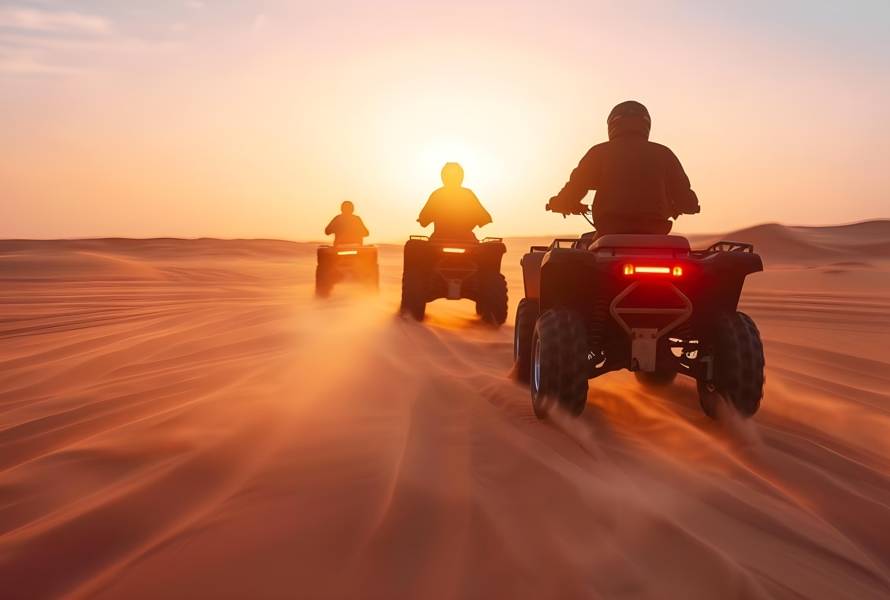
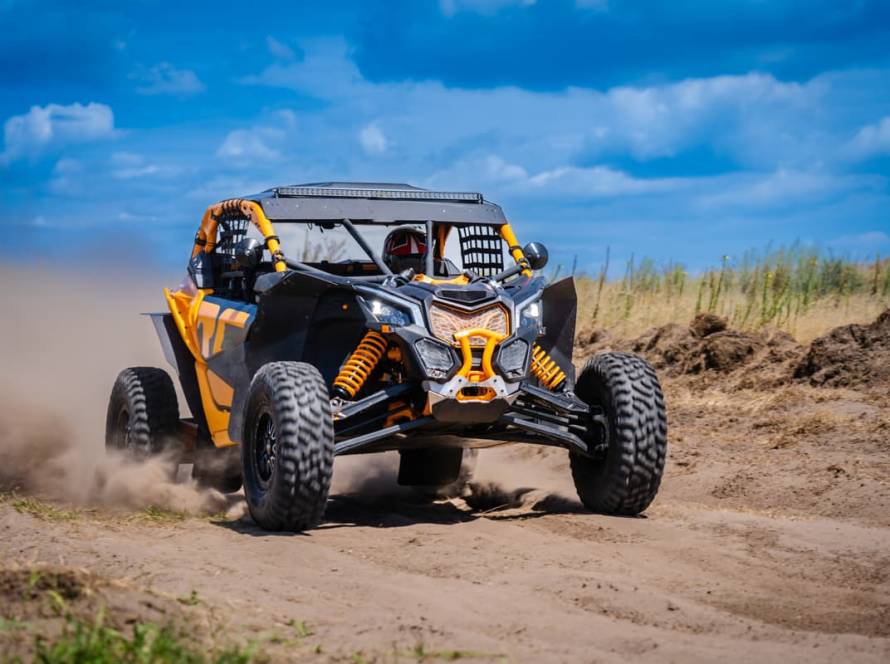
The Al Badayer desert is a sea of glowing red sand, where the massive “Big Red” dune stands as a challenge to every adventurer visiting Dubai. When you stand at the edge of these dunes, you are faced with a classic choice: how will you conquer the sand? In the world of desert thrills, your “chariot” defines your entire experience.
What is the difference between a dune buggy and an ATV? A dune buggy is a “side-by-side” vehicle equipped with a steering wheel, foot pedals, and a protective steel roll cage, offering a car-like driving experience. In contrast, an ATV (All-Terrain Vehicle), often called a quad bike, is a straddled machine with handlebar controls and a thumb throttle, designed for solo agility and a more physical, motorcycle-style ride.
As licensed Dubai tour experts with over a decade of experience, we have helped thousands of first-time visitors navigate this choice. We’ve seen families enjoy the shared comfort of a buggy and solo travelers find their spark on a nimble quad bike. Our mission is to ensure you choose the vehicle that matches your comfort level and your hunger for adventure, all while staying safe under the desert sun. Whether you want to sit back in a bucket seat or lean into a sharp turn on handlebars, understanding these machines is the first step to an unforgettable desert day.
Design and Controls: Car-like Comfort vs. Motorcycle Agility
When you look at these two machines side-by-side in the Al Badayer sands, the first thing you will notice is how differently they are built. Their chassis designs are worlds apart, which completely changes how you control them and how much energy you use during your ride.
Dune Buggy Mechanics: Familiar and Friendly
A dune buggy is often called a “Side-by-Side” because the driver and passenger sit next to each other in bucket seats. For most tourists, a buggy feels very familiar because it uses the same controls as a standard car. You have a steering wheel, a gas pedal on the right, and a brake pedal on the left. Most modern desert buggies, like the high-performance Can-Am or Polaris models, feature an automatic transmission. This means you don’t have to worry about shifting gears; you simply put it in “Drive” and focus on the dunes. With long suspension travel, the buggy’s frame absorbs the bumps, allowing you to stay seated comfortably while the vehicle does the hard work.
ATV Mechanics: The Sporty Straddle
An ATV, or Quad Bike, is built more like a motorcycle. Instead of sitting in the vehicle, you sit on top of it in a straddle seat. You steer using handlebars, and the throttle is usually controlled by a lever you push with your thumb. While many ATVs in Dubai also feature automatic transmissions, the way you move is much more manual. Because an ATV has a narrower frame and sits higher up, it is a very “active” ride.
Physical Demand: Relaxing vs. Active Riding
The biggest difference for many travelers is the physical demand. In a dune buggy, you are strapped in and can sit back; the vehicle is stable and handles the leaning for you. On an ATV, you must use your own body weight to stay balanced. When you turn a corner on a quad bike, you often have to lean your body into the turn to keep the wheels grounded. This “active riding” is a great workout and feels very connected to the sand, but it can be tiring after an hour. If you prefer a more relaxing, car-like experience with plenty of power and engine displacement (cc) to spare, the buggy is your best bet.
Safety Comparison: The Roll Cage vs. The Open Frame
In the vast expanse of the Al Badayer dunes, safety is the single most important factor to consider before choosing your ride. While both vehicles are designed for off-road fun, they offer very different levels of protection. Understanding these differences is essential for ensuring your desert adventure remains a positive memory.
Buggy Protections: The Structural Safety Bubble
A dune buggy is widely considered the safer option for beginners and families due to its structural design. Every commercial buggy in Dubai must feature a Roll-Over Protection Structure (ROPS) commonly known as a roll cage. This heavy-duty steel frame is engineered to support the entire weight of the vehicle, keeping the occupants safe even if the buggy tips over on a steep slope.
Inside the cabin, you are secured by a 4-point or 5-point safety harness rather than a standard car seatbelt. These harnesses lock both shoulders and your waist into a reinforced bucket seat, preventing you from moving around during sharp turns or bumpy descents. In a buggy, you are essentially sitting inside a protective metal “bubble” that absorbs the impact of the terrain.
ATV Risks: The Open Frame Challenge
An ATV is an “open frame” vehicle, meaning there is no cage or roof around the rider. The primary safety challenge with an ATV is its higher center of gravity. Because the rider sits on top of the machine rather than inside it, the vehicle can become unstable if turned too sharply or driven across a steep incline incorrectly.
For inexperienced riders, there is a risk of “tipping” or the vehicle rolling over.2 Unlike a buggy, where you stay strapped inside during a roll, an ATV rider can be thrown from the vehicle. This is why active riding leaning your body to balance the quad—is so important. While ATVs are incredibly fun, they require much more focus and physical control to operate safely on high dunes.
Essential Gear for All
Regardless of which vehicle you choose, certain safety gear is mandatory. Both buggy and ATV riders must wear full-face helmets to protect against head injuries and goggles to keep fine desert sand out of their eyes. However, the buggy provides an extra layer of defense against the elements and potential rolls that the open-frame ATV simply cannot match.3 If you are looking for the highest level of security while still enjoying the thrill of the “Big Red” dunes, the structural protection of a buggy is the clear winner.
Terrain Performance: Who Rules the Red Dunes?
When it comes to the towering landscape of Al Badayer, both the dune buggy and the ATV have their own way of claiming the sand. The terrain here is famous for its steep inclines and soft pockets, and how you navigate them depends entirely on the machine beneath you.
Climbing Power: The Buggy Advantage
If your goal is to reach the peak of “Big Red” without breaking a sweat, the dune buggy is the king of climbing. High-performance models, such as the Can-Am Maverick, are equipped with high-torque engines specifically tuned for the desert. These engines provide a massive amount of “push” that allows the buggy to handle steep Al Badayer inclines effortlessly. Even with two or four passengers, the power-to-weight ratio ensures you can crawl up vertical faces that might leave other vehicles struggling.
Agility & Maneuverability: The ATV’s Playground
While buggies rule the long climbs, ATVs own the technical sections. Because of their short wheelbase and lightweight frame, ATVs are superior for tight “bowl” riding. If you want to carve sharp S-turns or zip through narrow gaps between smaller dunes, the quad bike offers a level of agility a larger buggy cannot match. The ability to use your body weight to flick the bike from side to side makes the ATV feel like a surgical tool for the sand.
Staying Atop the “Sugar Sand”
The sand in Dubai can be incredibly fine, often called “sugar sand.” This is where weight distribution becomes vital. Dune buggies use very large, wide-profile sand tires that create a massive footprint. This allows the heavy vehicle to “float” on top of the soft sand rather than sinking into it. While ATVs are lighter, their tires are smaller, requiring the rider to maintain a steady speed to avoid getting stuck. In a buggy, the wide tires and consistent power give you a more forgiving ride through the softest parts of the Al Badayer dunes.
Group Dynamics and Passenger Capacity
One of the biggest factors in your decision should be who you are traveling with. The desert is a place for making memories, and the vehicle you choose will change how you share those moments with your group.
Family-Friendly Buggies: Room for Everyone
Dune buggies are the ultimate choice for families and couples. Unlike bikes, buggies come in 2-seater and 4-seater options. This makes them the perfect chariot for parents who want their children to experience the thrill of the “Big Red” dunes safely. In a 4-seater buggy, a family of four can tackle the sand together, with the kids securely buckled into the back seats while the parents take the lead up front. It turns a solo sport into a shared family adventure.
Solo Thrills and Legal Rules
ATVs are built for individual explorers. In Dubai, there are strict legal restrictions regarding passengers on quad bikes; most commercial ATVs are single-rider vehicles. This means if you have a group of four, you will need four separate bikes. While this is great for those who want total independence and “solo thrills,” it can be challenging for families with younger children who aren’t old enough to drive their own machine.
The Social Aspect
There is a unique social joy in a buggy that you don’t get on an ATV. Because you are sitting side-by-side, you can actually talk, laugh, and point out sights to each other in real-time. On an ATV, the combination of a helmet, wind noise, and separate bikes makes it much harder to communicate. In a buggy, when you crest a massive dune and see the Arabian sun, you can share that “wow” moment instantly with the person sitting right next to you.
Legal and Licensing Requirements in Dubai
Before you hit the gas in the Al Badayer sands, it is important to understand the specific rules set by the Roads and Transport Authority (RTA). Dubai has strict regulations to ensure that desert fun doesn’t compromise safety or public order.
Age Limits: Who Can Drive?
The legal age to drive a dune buggy or an ATV in Dubai is 16 years old. This age limit is standard across professional tour operators and is designed to ensure the driver has the physical strength and maturity to handle the vehicle on shifting sand. If you are traveling with younger children, they can still join the fun as passengers in a buggy. Most operators allow children aged 5 and up to ride in the passenger seat, provided they are accompanied by an adult and can be securely strapped into the safety harness.
The License Myth: Do You Need One?
A common question from tourists is whether a standard driving license is required. For guided tours in designated off-road zones, the answer is usually no. Because these tours take place in controlled desert areas under expert supervision, a specialized “desert license” is not required for tourists. However, you must bring a valid form of identification—either your Passport or Emirates ID—for verification and record-keeping. Some premium high-performance buggy rentals may ask for a license just to verify your driving experience, so it is always a good idea to have a copy of your home country license handy.
Zone Restrictions: Keeping It Off-Road
The most critical legal rule is that dune buggies and ATVs are strictly for off-road use only. It is illegal to drive these vehicles on public streets, highways, or in residential areas. These machines lack the indicators, mirrors, and safety features required for city traffic. If caught driving on a public road, the vehicle can be seized immediately, and fines can reach up to AED 50,000. To stay safe and legal, always start and end your ride at the designated desert camp and stay within the areas marked by your guide.
Cost Analysis: Budget-Friendly vs. Premium Experience
Choosing between an ATV and a dune buggy often comes down to your vacation budget. Because these two vehicles are built differently, their rental prices reflect the technology and maintenance required to keep them running in the harsh desert heat.
Price Breakdown: Why the Gap?
Typically, a 30-to-60-minute ATV (Quad Bike) session in Dubai ranges from AED 200 to AED 600. In contrast, a Dune Buggy rental starts around AED 380 and can go up to AED 1,200 or more for high-end models like the Can-Am Maverick.
There are three main reasons for this price difference:
-
Maintenance & Parts: Buggies are more complex machines. Their high-travel suspension and powerful engines require specialized parts that are much more expensive to replace than those on a quad bike.
-
Fuel Consumption: A 1000cc buggy engine consumes significantly more fuel than a standard 350cc or 450cc ATV engine.
-
Safety Standards: The cost of RTA-mandated roll cages, 4-point harnesses, and bucket seats is built into the buggy’s rental price, providing you with a premium safety “bubble.”
Value for Money
When looking at the total cost, a buggy can actually be more economical for groups. For example, renting four individual ATVs might cost you AED 1,600 (at AED 400 each). However, a single 4-seater dune buggy might only cost AED 1,200 for the same duration. For families or groups of friends, the buggy offers a better “per person” price while allowing everyone to share the same vehicle and the same exciting moments. If you are a solo traveler looking for the cheapest thrill, the ATV is your best bet, but for groups, the buggy is the king of value.
The Verdict: Which One Should You Choose?
After exploring the vast red dunes of Al Badayer, the choice between a dune buggy and an ATV comes down to the kind of memory you want to create. Both vehicles offer a world-class thrill, but they cater to very different styles of adventure.
Choose a Dune Buggy if:
You are looking for a shared experience where safety and comfort are the top priorities. The buggy is the perfect choice for families with children, couples who want to sit side-by-side, or beginners who feel more confident with car-like controls. If you want to tackle the tallest dunes in a “safety bubble” with a powerful engine doing the hard work, the buggy is your ultimate desert chariot.
Choose an ATV if:
You are a solo adrenaline-seeker who wants a raw, hands-on connection with the sand. The ATV is ideal if you are on a tighter budget but still want maximum excitement. It is the best pick for those who enjoy a physical challenge and the freedom of a nimble, motorcycle-style ride. If you don’t mind a little extra sand and want to test your balance against the desert, the quad bike is waiting for you.
Whichever you choose, the sands of Dubai promise an adventure like no other.
Conclusion: Booking Your Adventure
Whether you choose the shared comfort of a dune buggy or the solo intensity of an ATV, both vehicles offer a unique and unforgettable way to see the Arabian sunset. As the sky turns to shades of amber and violet over the “Big Red” dunes of Al Badayer, you’ll realize that the desert is more than just sand it’s a place for world-class thrills and lasting memories.
By choosing a licensed operator, you ensure that every part of your journey follows Dubai’s strict safety and environmental laws. From the moment we pick you up to the final photograph at dusk, our focus is on providing a professional, legal, and high-energy experience.
Can’t decide between the two? We offer custom Combo Tours that allow you to test both machines in a single session. Contact our expert team today to book your tailored package and experience the very best of the Al Badayer desert!
Frequently Asked Questions
Q: Can I switch from an ATV to a buggy during my tour?
A: No. For safety and insurance reasons, you must stay with the vehicle you booked for the duration of the session. If you want to try both, it is best to book a “Combo Tour” that allows for separate time slots on each machine.
Q: Is a dune buggy safer than a quad bike?
A: Yes. A dune buggy is built with a steel roll cage and safety harnesses that protect you inside a frame. An ATV is an “open” vehicle that requires you to balance with your body, making it easier to tip over if you are inexperienced.
Q: What should I wear for a desert buggy or ATV ride?
A: Wear comfortable, loose-fitting clothes like t-shirts and long pants to protect your skin from the sun and sand. Most importantly, you must wear closed-toe shoes (sneakers or boots). Avoid sandals, flip-flops, or long, loose scarves.
Q: Do I need insurance for off-roading in Dubai?
A: Yes. While licensed operators provide basic vehicle insurance, we highly recommend having personal travel insurance with an “Adventure Sports” cover. This ensures you are protected for medical costs, as many standard policies do not cover off-road driving.
Q: Which is better for photography and Instagram reels?
A: Buggies are best for stable, cinematic videos and group photos. ATVs are better for “action shots” that show off your riding skills and sand-kicking turns. Both look incredible during the “Golden Hour” just before sunset.