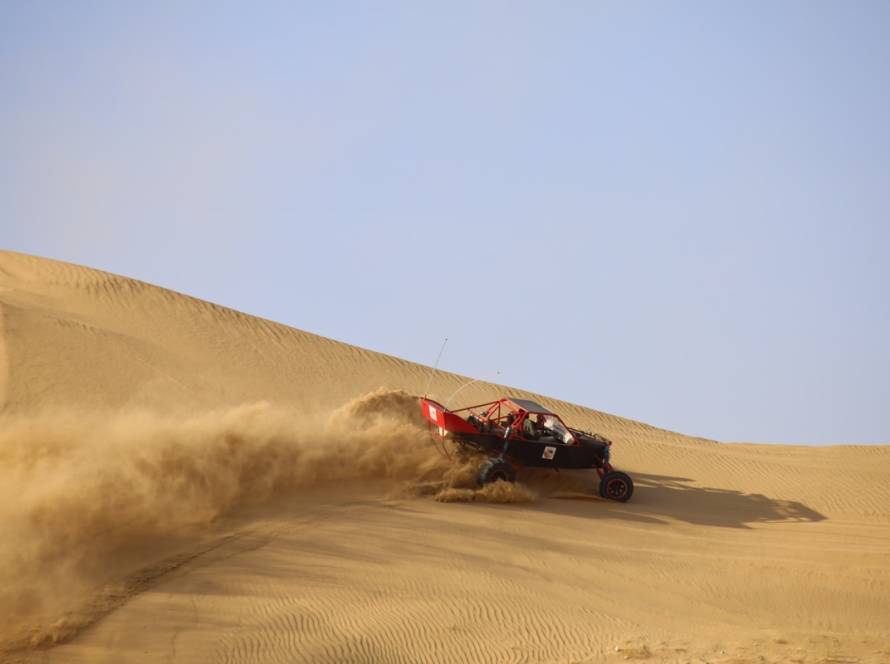
If you are planning your first trip to the Dubai desert, the short answer is yes – driving a dune buggy is remarkably safe for beginners. While the towering dunes look intimidating, modern buggies are specifically engineered with roll cages, safety harnesses, and automatic transmissions that make them easier to handle than a standard car. As long as you follow your guide’s instructions and respect the desert terrain, you can enjoy the ultimate adrenaline rush with total peace of mind.
The Verdict: Safety vs. Thrills for First-Timers
When people imagine a desert adventure, they often picture high-speed stunts from action movies. In reality, modern dune buggy tours in Dubai are designed to balance adrenaline with maximum security. The secret lies in the vehicle’s engineering. Unlike a standard car, a professional desert buggy is built around a reinforced steel roll cage. This skeleton is designed to protect the cabin entirely in the rare event of a tip-over. Inside, you aren’t just wearing a standard lap belt; you are strapped into a four or five-point safety harness that keeps you firmly seated, even when navigating steep dunes.
If you are choosing between a dune buggy and a quad bike, the buggy is the clear winner for safety. On a quad bike, your body is exposed, and you must use your physical weight to balance the machine. If you lose your footing, there is a risk of falling off. In a dune buggy, you sit inside a protected “cockpit” with a familiar steering wheel and foot pedals. Because of the wider wheelbase and lower center of gravity, buggies are significantly more stable on shifting sand. For a first-timer, this means you can focus on the spectacular views and the thrill of the climb without worrying about your balance.
Understanding Dune Buggy Mechanics: Built for the Desert
When you step into a professional-grade buggy, you aren’t just driving a modified golf cart; you are operating a high-performance machine specifically engineered for the harshest terrain on Earth. In Dubai, most top-tier tour operators use industry leaders like the Can-Am Maverick X3 or the Polaris RZR. These vehicles are the gold standard because they are built from the ground up to handle soft, shifting sand without breaking a sweat.
One of the most important safety features is the long-travel suspension. If you look at the wheels of a Polaris or Can-Am, you’ll notice heavy-duty shocks that can move up and down significantly sometimes up to 20 or 24 inches. This allows the buggy to “soak up” the bumps and dips of the dunes. Instead of the vehicle bouncing uncontrollably when you hit a pocket of soft sand, the suspension stays glued to the ground, keeping the cabin level and stable.
Furthermore, these buggies are designed with an incredibly low center of gravity. The engine and heavy components are placed as low as possible within the frame, and the wheels are pushed out wide to the corners. This wide “stance” makes the buggy naturally resistant to tipping. Even when you are driving along the side of a dune at an angle, the weight distribution works to keep all four tires firmly planted.
Combined with high-grip, low-pressure sand tires, these mechanics mean the buggy does most of the hard work for you. As a first-time driver, you don’t need to be a mechanical expert to feel the difference; the machine feels planted, responsive, and remarkably sturdy, allowing you to navigate the desert with confidence rather than caution.
5 Crucial Safety Protocols Every Dubai Operator Must Follow
When booking a desert adventure, your safety depends as much on the company you choose as it does on the vehicle you drive. In Dubai, the best tour operators adhere to strict safety standards to ensure that every guest returns with nothing but great memories. Before you click “book,” look for these five non-negotiable safety protocols that distinguish a professional team from a budget-quality provider.
1. Professional Safety Gear as Standard
A reputable operator will never let you leave the base without a high-quality, full-face helmet and specialized sand goggles. These aren’t just for show; the helmet protects your head from cabin vibrations, while the goggles are essential for visibility, keeping fine desert dust out of your eyes so you can stay focused on the track ahead. As mentioned before, ensure your buggy is equipped with a professional 4-point harness that secures both your waist and shoulders.
2. The “Lead and Sweep” System
You should never be sent into the dunes alone. A professional tour uses a “sandwich” formation. A Lead Marshall—an expert driver with years of desert experience heads the convoy to pick the safest path through the dunes. At the very back is the “Sweep” driver. This backup expert stays behind the last guest to ensure no one gets lost, stalls their engine, or falls behind. This two-man system ensures help is always seconds away.
3. Mandatory Pre-Drive Safety Briefing
Before you even touch the ignition, your guides should provide a 10 to 15-minute safety briefing. This covers hand signals, how to maintain a safe distance from the buggy in front of you, and how to approach a dune at the correct angle. If a company skips this talk, it’s a major red flag.
4. Real-Time Communication
The lead car and the backup vehicle should always be in radio contact. This allows the team to alert each other about changing sand conditions, oncoming tour groups, or any mechanical issues instantly.
5. On-Site First Aid and Recovery Tools
A trustworthy operator carries comprehensive first-aid kits and professional recovery gear, such as kinetic ropes and sand plates. While you likely won’t need them, knowing that your team is prepared for any scenario—from a flat tire to a minor medical need—provides the ultimate peace of mind.
Step-by-Step: Your First 15 Minutes in the Driver’s Seat
The first quarter-hour of your desert adventure is designed to transform your initial nerves into pure confidence. Before you even turn the key, your journey begins with a hands-on briefing. Your guide will walk you around the vehicle, showing you exactly how to adjust your seat for the best visibility and how to click into your safety harness so it’s snug but comfortable. This isn’t a boring lecture; it’s a practical “show and tell” where you’ll learn the hand signals the lead driver will use to tell you when to speed up, slow down, or stop.
One of the biggest surprises for first-time drivers is how familiar the controls feel. If you have a standard driver’s license and have driven an automatic car, you already have 90% of the skills required. Modern buggies use a CVT (Continuously Variable Transmission), which is essentially a high-tech automatic system. There is no clutch to worry about and no gears to shift manually. You have a gas pedal to go and a brake pedal to stop. This simplicity allows you to keep both hands on the wheel and your eyes on the stunning dunes ahead, rather than fumbling with a gear stick.
[Image showing the simple cockpit of a buggy: Steering wheel, gas, and brake]
The most important lesson you’ll learn in those first 15 minutes is the concept of “Sand Momentum.” Unlike driving on asphalt, sand is a fluid surface that creates natural resistance. If you stop halfway up a dune, you might get stuck. Your guide will teach you that “momentum is your friend.” Instead of slamming on the brakes when things feel bumpy, you’ll learn to ease off the throttle. In fact, braking hard on a soft slope can actually cause your tires to dig a hole and bury themselves. You’ll quickly find a rhythm: steady pressure on the gas to climb, and letting the sand’s natural friction slow you down as you crest the top. By the time the first 15 minutes are up, you’ll be amazed at how intuitive driving on sand actually feels.
Common Mistakes First-Time Drivers Make (and how to avoid them)
Even the most experienced road drivers find that the desert plays by a different set of rules. To keep your ride smooth and safe, it helps to know the typical slip-ups beginners make during their first hour on the dunes. By identifying these early, you can stay in control and enjoy the desert like a pro.
Over-correcting on a slide
When you feel the back of the buggy start to slide or “drift” on soft sand, your natural instinct might be to jerk the steering wheel hard in the opposite direction. On the road, this might work, but in the dunes, it can cause the tires to dig in too deep. Instead, keep your steering movements smooth and steady. If the back slides, gently steer into the direction of the slide and maintain a little bit of throttle. The buggy’s wide wheelbase is designed to find its grip—you just need to give it a second to settle.
Tailgating the lead car
In a city, staying close to the car in front is common. In the desert, it’s a safety hazard. If the Lead Marshall stops suddenly to check a dune or if the buggy in front gets stuck, you need plenty of “braking room.” Sand doesn’t offer the same instant stopping power as tarmac. Always keep at least three to four buggy-lengths between you and the vehicle ahead. This gap also gives the dust from their tires time to settle, ensuring you always have a clear view of the tracks.
Slamming the brakes on a downhill
It’s natural to feel a bit of “descending anxiety” when you point the nose of the buggy down a tall dune. However, slamming on the brakes is the quickest way to lose steering control. When you lock the wheels on a steep slope, the buggy can start to sled sideways. The better approach is to let the engine do the work. Take your foot off the gas and apply light, rhythmic pressure to the brakes if needed. Let the buggy roll straight down the “fall line” of the dune.
Getting stuck on “razor-back” dunes
A razor-back is a dune with a very sharp peak. If you go too slowly, the middle of your buggy might get “high-centered” on the crest, leaving your wheels spinning in the air. To avoid this, maintain steady momentum until your front wheels cross the peak, then immediately ease off the gas as you begin the descent. If you do get stuck, don’t keep spinning your tires—that just digs you in deeper. Simply wait for your Sweep driver to give you a quick tug out.
Who Should Sit This One Out? (The Fine Print)
While dune buggying is an inclusive activity, the extreme nature of the desert terrain means it isn’t suitable for everyone. To ensure your safety and comply with Dubai’s strict tourism regulations, there are a few “fine print” items you need to know before you arrive at the camp.
Health and Physical Requirements
Because the ride involves bumps, vibrations, and sudden movements, it is not recommended for pregnant women, especially those in their first or third trimester. Similarly, if you have a history of chronic back or neck injuries, the jolting motion of off-road driving can aggravate these conditions. Most operators also advise against the activity for individuals with serious heart conditions or those who have recently undergone major surgery.
Age and Licensing for Tourists
The rules for international visitors are surprisingly simple. To drive a high-powered buggy (like a 1000cc Polaris), you generally need to be 16 to 18 years old. The good news is that you do not need a special UAE driving license or even an International Driving Permit to drive on a guided desert tour. As long as you are on a designated off-road track with a professional operator, a valid passport or a driver’s license from your home country is usually all the identification required.
For families, children as young as 6 to 10 years old can often join the fun as passengers in a two-seater or four-seater buggy, provided they can be safely secured in the harness and wear a helmet. Always check with your specific operator beforehand, as age limits can vary slightly based on the power of the engine.
Conclusion: Ready to Kick Up Some Dust?
Stepping into the vast, golden dunes of Dubai for the first time is an experience that stays with you forever. While the power of a Can-Am or Polaris buggy might seem intimidating at first glance, the reality is that these machines are built to be your partner in the sand. By choosing a reputable operator, wearing the right safety gear, and listening to your expert guides, you are setting yourself up for an adventure that is as secure as it is exhilarating.
Remember, every expert driver was once a beginner. The “Safety First” mindset of Dubai’s professional tour teams ensures that you don’t need years of off-road experience to enjoy the desert’s beauty. Whether you are navigating your first “razor-back” dune or simply enjoying the wind in your face as you cruise across the open plains, you are in a vehicle designed to protect you every step of the way.
Don’t let a little bit of nerves hold you back from one of the world’s most unique travel experiences. The desert is waiting, the engines are ready, and your safety is guaranteed. It’s time to grab your goggles, strap in, and create memories that will last a lifetime.
Frequently Asked Questions
Q: Do I need a special license to drive a dune buggy in Dubai?
A: No, you do not need a special off-road license or a UAE-specific permit. Most tour operators only require a valid driver’s license from your home country and your passport for identification. As long as you are at least 16 to 18 years old (depending on the specific operator), you are legally eligible to drive.
Q: What happens if the buggy flips over?
A: While flips are extremely rare due to the wide wheelbase of the vehicles, the buggies are built for this exact scenario. Every professional buggy features a reinforced steel roll cage and 4-point safety harnesses. If a tip-over occurs, the cage prevents the vehicle from crushing, and the harness keeps you securely inside the “safety cell.” Your lead marshall is also trained to right the vehicle safely and check for any mechanical issues before you continue.
Q: What should I wear to stay safe during the ride?
A: Safety starts with your outfit. Wear comfortable, breathable clothing that covers your skin to protect against sun and flying sand. Closed-toe shoes, such as sneakers or hiking boots, are mandatory—never drive in flip-flops or sandals, as they can slip off the pedals. Your operator will provide the most critical gear: a full-face helmet and sand-proof goggles.
Q: Is insurance included in my booking?
A: Most reputable Dubai tour operators include basic third-party liability insurance in the booking price. However, this typically covers the operator’s liability and not personal injury or damage caused by reckless driving. It is highly recommended to check if your personal travel insurance covers “extreme sports” or “off-road driving.” Always read the waiver provided by the operator to understand your level of coverage.
Q: Can I bring a passenger if I am a first-time driver?
A: Yes! Most buggies come in 2-seater or 4-seater models. As long as you feel confident after your initial 15-minute briefing, having a passenger is perfectly safe and a great way to share the thrill.